Thursday, February 14, 2013

Jiu Jitsu Beginner Tip #3: You're Going to Get Your Ass Kicked Often

Whenever we begin a new activity, we struggle. That's part of the appeal of being a complete novice. In the case of jiu jitsu, that struggle will be manifested with frequent ass-kickings. Those with more experience will submit you on a regular basis.

That's a good thing.

If we check our ego at the door, we won't frame the experience as winning or losing. We'll frame it as an opportunity to learn... and nothing teaches better than failure. 

If you have no grappling experience (wrestling, judo, etc.), the very nature of rolling around will seem foreign. First, it's physically difficult. The sensation of many muscles contracting for extended periods of time is exhausting.

Second, learning balance and body positioning takes time. Grappling of any type requires a good sense of proprioception (position of your own body) in addition to the position of your opponent's body.

Third, learning the progression of positions and related terminology takes time. I'm just now getting to the point (after about six weeks of training) where I know which positions are more advantageous than others. 

If you DO have grappling experience, that can be both positive and negative. I have some wrestling experience. In the neutral position where both people are standing, it's an advantage. I already know how to do a variety of takedowns. Once we hit the ground, though, the wrestling experience is usually a disadvantage. The goals of wrestling are far different than jiu jitsu. For example, I instinctively want to go to my belly, which is usually a HUGE no-no in jiu jitsu. I've had to unlearn a lot of behaviors as a result. 

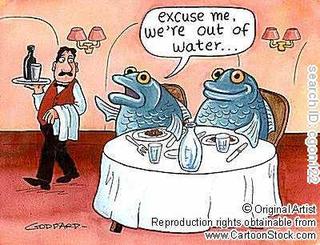
So about this "getting your ass kicked" thing- it's going to happen. There's a saying in jiu jitsu- "Tap early and tap often." It's a friendly way to explain the concept of embracing the learning experience. In the very beginning, anyone and everyone with experience will dominate us. We'll more or less flail around like a fish out of water. They'll choke us, catch us in an arm bar... whatever. When this happens, we should just tap as soon as we're obviously caught, consider what position we were in, and try to figure out what we did wrong. 

Don't wait to tap. Most people will continue choking or hyperextending your joints until we DO tap. They rely on us to keep them from injuring us. I've been guilty of this on occasion... I've tried escaping an arm bar and ended up tweaking my elbow. Don't make that stupid mistake.

After a few weeks, we'll start to learn which positions to avoid. We'll quickly learn to stop making stupid mistakes. Our movements become more efficient. At the same time, we'll learn some basic movements like passing the guard or escaping the mount. Eventually we'll learn a few submissions. All of these skills will start to come together after a month or three and we'll actually begin to practice something that looks like jiu jitsu.

At this point, it's important to continue with the "tap early and tap often" philosophy. Work with people that have more experience than you. While it may be tempting to feed your ego by submitting the newer people in class, it probably won't help your progression. Seek adversity and continue to learn. That's how we'll continue to improve.

In the beginning, we're going to got our asses kicked. We need to embrace it as an opportunity, not a blow to our self-worth. Everyone was once in our "newbie" position. The fastest way to learn is to accept the ass-beatings and learn from the experience.

###


Sunday, February 10, 2013

Jiu Jitsu Beginner Tip #2: Use Imagery to Always Train

They key to improving at anything is practice. The more you repeat any given movement, the more proficient you become. This principle applies to jiu jitsu just as much as running, playing the guitar, or mastering your bedroom skillz.

There's a problem, though. Few of us have unlimited time to drill movements for hours every day. Even if we did, we'd likely suffer from overtraining. Jiu jitsu is a fairly intense physical activity. In the beginning, our bodies aren't going to be prepared for the demands placed on our soft tissues or even bones.

The solution- use imagery.

Using imagery is simple. Find a quiet place. Relax. Close your eyes. Using as much detail as possible, imagine doing any given movement perfectly. If you don't know exactly how to do a particular movement, check out YouTube or ask someone at the gym. Repeat the movement multiple times in your head. Move on to another movement. The more you can engage every sense (imagine what if feels like, imagine what you see, smell, hear, etc.), the more effective the imagery session becomes.

Back in high school, one of my wrestling coaches tried to convince us to use imagery multiple times per day. Being a somewhat lazy high school student, I didn't see the point, so I didn't do it. Had I actually used the methodology, I would have been a much more well-rounded wrestler.

Later in my college career, I studied sport psychology. We discussed the research extensively. As it turns out imagery is almost as effective at learning and perfecting new movements as actually practicing the movement. In other words, you can see almost as much improvement by imagining the perfect movements as if you actually hit the mats and practiced.

A few years after college, I used imagery when coaching football. Among my duties was coaching our place kickers. We used imagery extensively during practice and on the sidelines before and during games. The results were great... we had exceptionally accurate field goal and extra point kickers. 

I later used imagery myself when learning to run technical trails. Since it was impossible to practice on remote, rugged trails on a daily basis, I'd take a few minutes each day and imagine running over gnarly terrain. The results were great- I improved much faster than I would have without that mental practice.

Back to jiu jitsu. After each training session, I make a note of the movements, techniques, or submissions we learned that day. I have a running list of everything we've practiced. Since us new white belts practice the same things as the more experienced members, I rank things based on comfort level. Some things come easily or are fundamental building blocks for many different movements. For example, I imagine shrimping and upa movements A LOT. I also use imagery to practice passing guard, takedowns, and some common counters to popular submissions.

Some of the more advanced things we cover will be added to the list, but I don't mentally practice them as often. As comfort level grows, I may add some of these to the higher priority list.

For me, the key is to become extremely proficient at a very small number of things instead of being mediocre at a bunch of things. As a wrestler in high school, I had a lot more success with the latter approach. I had two or three moves from every position that I used all the time. I had a few more that weren't as smooth, but could be used to set up my bread and butter.I could have been a much better wrestler had I actually used imagery to practice both my primary and secondary moves.

Imagery is the secret to working on those "A" game primary movements. It allows you to overcome the limitations of time and physical endurance.


###


Tuesday, February 5, 2013

Jiu Jitsu Beginner Tip #1: Work on Grip Strength

Since most jiu jitsu is practiced wearing a gi, learning to use it for both offensive and defensive purposes is critically important. I'm not at that point yet. In fact, my opponents routinely pull and twist my gi in ways that seem to defy the laws of science. I'm pretty sure I've been choked with my own pant leg.

Anyway, I did learn one important lesson- strengthening our grip makes all the difference. 

The ability to grasp, twist, and maintain a hold on our opponent's gi allows us to do a lot of stuff. If they can't break our grip, it gets a lot more difficult to escape, pass guard, or counter a submission.

Jiu jitsu isn't the only reason peopel build grip strength. Apparently it's a hobby. People also build it for recreational purposes:


How's that for an obscure character reference? ;-)
 
Anyway, how do we build grip strength?

There are a lot of devices on the market designed build grip strength. I prefer the simple approach- racket balls. They're cheap. Easy to find. Simple to use. I like to use the following routine:
  • Hold the ball with your index and middle fingers. Squeeze the ball hard 20 times.Switch hands, repeat.
  • Hold the ball with your pinky and index fingers. Squeeze the ball hard 20 times. Switch hands, repeat.
  • Hold the ball with your middle and ring fingers. Squeeze the ball hard 20 times. Switch hands, repeat.
  • Hold the ball between your thumb and index finger. Squeeze hard with your thumb 20 times. Switch hands, repeat.
  • Hold the ball in the middle of your hand. Squeeze hard 20 times with all your fingers. Switch hands, repeat.
Start with this routine once per day for a week. Add one complete set each subsequent week. You're be tearing phone books in half in no time. And dominating your opponent with your iron grip!

###


Sunday, February 3, 2013

The First Month: Damn, This is a Steep Learning Curve!

I've been training at our mma gym for about a month. During that time, I've been learning the basics of boxing, kickboxing, and jiu jitsu. Coming into this experience, I knew virtually nothing about all three disciplines. Luckily I've had some great teachers. Here are a few early lessons:

Boxing: I had no idea how to actually throw a punch. After one session, I learned the basics: keep your wrist straight. Use your entire body instead of just your arms. Hit with your first two knuckles. Throw mostly straight punches. Immediately bring your hands back to protect your face. Use simple combinations like a left jab (#1) -> right cross (#2) -> left hook (#3.) Perhaps most importantly- don't close your eyes when you punch.

Oh, and punching the heavy bag sort of hurts. I'm sure it's due to the fact that I have the hands of a computer programmer. I'm told that it gets better. 

Kickboxing: Like punching, I also had no idea how to kick. I looked like a placekicker on stilts. It turns out technique is pretty important. So far I've learned a push kick, which is sort of like pushing someone directly in front of you with the sole of your foot. I've learned a flipper kick where I'd kick the inside of your left thigh with my left foot... sort of like you'd expect if fighting a dolphin. Finally I learned a Thai kick, which is a kick to the side of your target... with your shin. The foot has too many fragile easy-to-break bones.

Jiu jitsu: Jiu jitsu is a grappling art... sort of like wrestling with joint locks and choking. Lots of choking. And a uniform called a gi. At first it felt very intuitive due to my wrestling experience... until I realized every single instinct I had was wrong. Each "rolling" session basically went the same- my partner would do something, I'd use a wrestling counter that would put me in a bad position, they'd immediately throw me in an arm bar or choke of some sort. Getting choked was tricky at first- it induced a momentary panic. While in the midst of panic, I'd forget to "tap out" which indicates you more or less give up. I finally caught on by the third day. I'm a slow learner.

Choking really is a major component of jiu jitsu. I've had what feels like a perpetual case of strep throat for the last three weeks. Not only is choking an offensive strategy, it's also used as a counter to many moves. The repeated crushing of my trachea has resulted in some pretty serious bruising. Luckily I'm finally learning the art of tucking my chin. Again, I'm a slow learner.

The other challenging part of jiu jitsu was the gi, which is basically like a really heavy ninja costume. It's perfectly acceptable to grab your opponent's gi. In fact, most of the techniques involve various methods of grabbing and/or twisting your opponent's gi. There's nothing quite like the experience of getting choked by your own shirt.

All in all, the experience has been awesome. After years of specializing in running trail ultramarathons and developing a pretty high degree of competency, it's been refreshing to try an activity where I'm a complete newbie. The learning curve has been steep, but the initial progress has been rapid. 

There's something primal about getting your ass kicked on a regular basis. It's a little bit like the experience of running exceedingly long distances- there's a lot of lessons to learn, sometimes it hurts, and you know you're doing something most people are not willing to attempt. The feeling of venturing past the zone of comfort, which scary at times, is also exhilarating.

I'm looking forward to the coming months!

###